
A growing services company processes hundreds of invoices every month across multiple vendors.
- Invoices are received
- Entered the system
- Sent for approval
- Scheduled for payment within defined cycles
At a glance, everything seems structured.
However, as payment cycles progress, delays begin to appear. A few invoices turn overdue, while others remain stuck in approval longer than expected. Vendor follow-ups increase, and the finance team spends more time resolving these gaps than proactively managing payments.
Today, these delays seem minor. But over time, they begin to affect payment consistency.
Cash flow becomes hard to predict, vendor confidence declines, and internal effort shifts toward tracking and follow-ups rather than planning.
This shift doesn’t happen suddenly. It builds gradually as invoices move through different stages, where small delays often go unnoticed until they start affecting the overall payment cycle.
At this stage, overdue invoices are not random delays—they are the result of how the accounts payable process is being executed every day.
What Are Invoices in Businesses?
An invoice is a billing document that represents a financial commitment that the business is expected to honor within a defined timeline.
Every invoice carries three critical elements:
- Amount to be paid
- Due date
- Vendor obligation
It defines when and how cash will move out of the business.
In day-to-day operations, invoices directly influence:
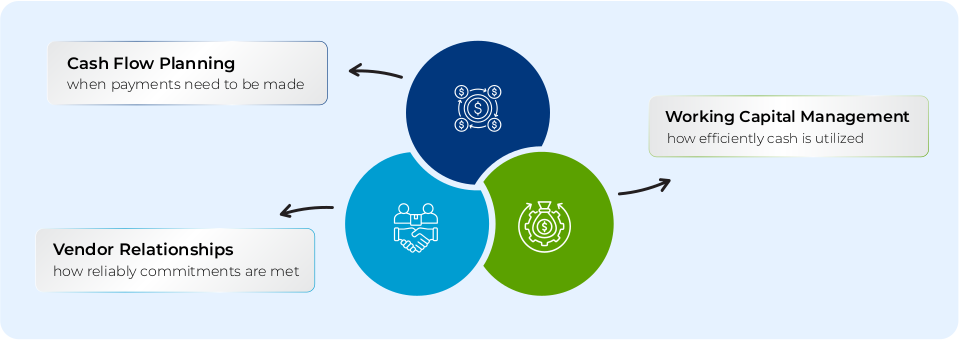
When invoices are managed well, payments follow a predictable pattern. Finance teams can plan disbursements with clarity, vendors remain confident, and cash flow remains stable.
However, when invoice management starts to slip, even slightly, the impact is immediate.
Payment timelines become uncertain, dependencies increase, and finance teams lose visibility into which obligations are ready for payment and which are still in process.
This is why invoices are not just transactional records. They are the starting point of the entire accounts payable cycle, and how they are handled determines whether payments remain under control or become inconsistent.
Challenges in Managing Invoices That Lead to Overdue Payments
Overdue invoices rarely result from a single issue. They build gradually as invoices move through the accounts payable process, where small inefficiencies compound into larger delays.
- Manual Data Entry and Process Fragmentation
Many businesses still rely on manual invoice processing, where invoices arrive in multiple formats—emails, PDFs, scanned copies, or documents. This creates dependency on manual data entry, increasing both time and error risk.
Even small mistakes, such as typos or incorrect entries, can disrupt the process. In fact, 86% of finance professionals identify manual data entry as a primary cause of payment errors, highlighting how early-stage inefficiencies directly affect outcomes. - Human Errors in Validation and Coding
Invoice validation often depends heavily on manual checks. Even experienced teams can make mistakes—incorrect invoice amounts, wrong coding, or missed payment terms.
These errors do not just require correction; they delay approvals, trigger disputes, and increase back-and-forth communication with vendors, pushing invoices closer to or beyond their due dates. - Time-Intensive Processing Cycles
Manual invoice handling is not just error-prone—it is slow.
Research shows that fewer than 15% of companies can process invoices within 3 days, indicating that extended processing cycles are common across businesses.
When validation, matching, and approvals take longer than expected, invoices miss scheduled payment windows, even if no major issue exists. - High Operational Cost of Inefficiency
Each step in manual processing—data entry, validation, matching, approvals—requires time and resources.
According to industry research, the average cost of processing a single invoice manually is around $15, compared to $2.36 with automated systems.
For businesses handling large volumes, this increases costs, limits scalability, and adds pressure on finance teams, leading to more frequent delays as volume grows.
These challenges do not impact independently.
A delay in data entry slows validation. Validation delays push approvals. Approval delays impact payment scheduling.
By the time the invoice reaches its due date, the delay is already built into the process.
How to Reduce Overdue Invoices
Reducing overdue invoices does not require introducing new tools. Most businesses already use invoicing or accounting systems. The issue is that invoices do not move through these systems consistently.
Today, invoices still get delayed because actions related to them are not taken on time. Approvals are pending, exceptions remain unresolved, and payment schedules are followed loosely. Even a well-defined system fails when invoices are not approved, resolved, and scheduled within expected timelines.
Automation improves the capture and processing of invoices. It brings structure to the workflow and reduces manual errors. A typical system ensures that:
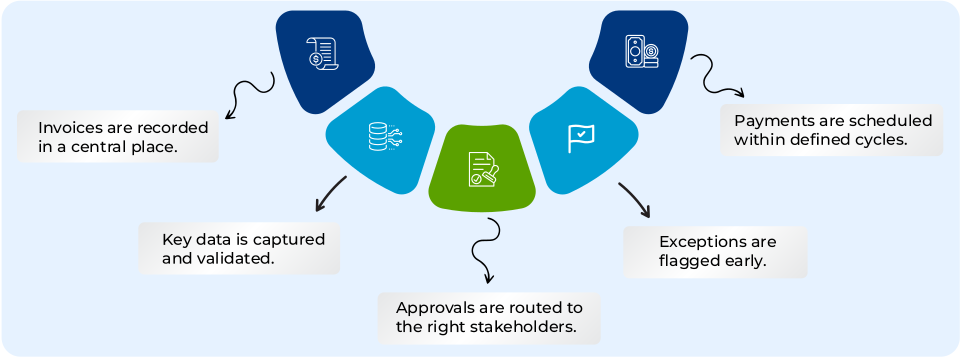
This creates visibility and standardization.
However, visibility alone does not prevent delays. An invoice can remain stuck if it is incomplete, incorrectly recorded, or not moved forward at the right time. Over time, these small gaps accumulate, pushing invoices past their due dates.
This is where outsourced accounts payable becomes relevant.
The challenge is not defining the process; it is sustaining it under real operating conditions.
As workloads fluctuate, internal teams naturally prioritize urgent and strategic tasks. Routine invoice handling becomes inconsistent, not because the process is unclear, but because execution cannot be maintained at the same level every day.
Outsourced accounts payable services address this gap.
It acts as a buffer between process design and day-to-day execution, ensuring that invoice flow remains stable without requiring constant internal intervention. Let’s understand it better.
How Outsourced Accounts Payable Services Can Add Value?
Outsourced accounts payable integrates within the existing system but adds a structured execution layer that ensures invoices move consistently.
The focus is not on changing decisions, but on ensuring that each step is completed on time, without gaps.
1. Invoice Intake and Standardization
Invoices from multiple sources—emails, PDFs, or vendor portals—are captured and brought into a single, trackable system. This removes dependency on scattered inputs and reduces the risk of invoices being missed or recorded late.
By standardizing how invoices enter the process, businesses gain early visibility into incoming liabilities. This ensures that every invoice starts its lifecycle on time, preventing delays from building at the very first stage.
2. Data Validation and Preparation
Before invoices move forward, they are reviewed for completeness and accuracy. Key details such as invoice amounts, dates, and references are verified, and any mismatches or missing information are identified early.
This preparation ensures that invoices that reach the next stage are already usable. As a result, downstream delays caused by incomplete or incorrect data are significantly reduced, allowing the process to move more smoothly.
3. Workflow Coordination
Invoices are routed through defined stages in alignment with the company’s existing structure. Instead of relying on manual coordination, each invoice follows a clear path from validation to the next stage.
This reduces idle time between steps and ensures that invoices do not get stuck due to lack of follow-through. Continuous tracking provides visibility into the status of each invoice, enabling timely movement through stages.
4. Exception Management
Discrepancies such as mismatches or missing information are handled through structured workflows rather than informal follow-ups. Issues are identified early and directed through predefined resolution paths.
By resolving exceptions within a defined framework, invoices are prevented from getting delayed indefinitely. This ensures that exceptions do not disrupt the overall flow of the process.
5. Payment Readiness and Scheduling Support
Once invoices are cleared, they are prepared for payment in alignment with defined cycles. Invoices are grouped by due date and business priority, ensuring payment planning is supported by accurate, ready-to-use data.
This reduces last-minute adjustments and ensures that invoices reaching the payment stage are already aligned with the intended schedule.
6. Monitoring and Control Layer
A continuous tracking mechanism ensures that invoices do not stall at any stage. Real-time visibility into invoice status helps identify delays early, allowing corrective action before deadlines are missed.
This layer maintains consistency across the process by ensuring that each step is completed as expected, without relying on reactive follow-ups.
Conclusion
As invoice volumes grow and processes become more complex, the focus needs to move beyond fixing delays to prevent them altogether. Businesses that rely solely on systems and internal coordination often find that execution gaps continue to surface over time.
The next step is not to add more layers, but to ensure the existing process runs consistently and with control.
By combining automation with a structured execution approach, businesses can build a more reliable accounts payable function—one in which invoices are processed on time, exceptions are handled early, and payment cycles remain predictable.
Outsourced accounts payable help enable this shift by supporting consistent execution without increasing internal complexity.
If overdue invoices are starting to affect your cash flow or vendor relationships, it may be time to reassess your accounts payable process. Let Accounting TO TAXES help you. Get in touch with our experts today.