

Agentic AI is rapidly becoming embedded in financial services operations. The global agentic AI marketin financial services is expected to grow from $2.1 billion in 2024 to $81 billion by 2034, with NorthAmerican institutions leading adoption through increased investment in automation and intelligentdecision-making capabilities.
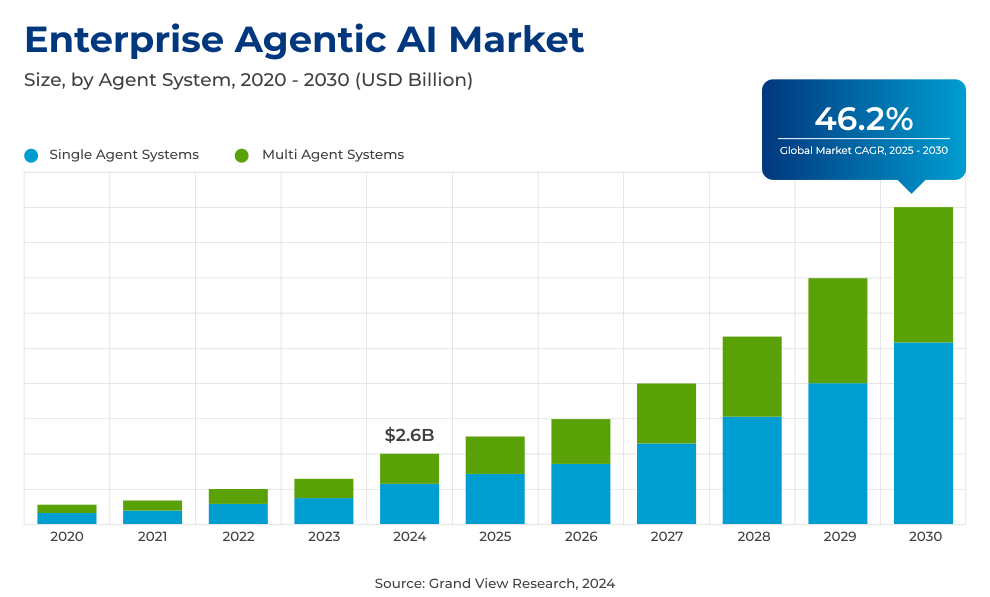
This growth reflects more than increased spending on AI tools. It signals a structural shift in howfinancial work is executed. Systems are no longer limited to running predefined rules or escalatingexceptions for human review. They are increasingly capable of interpreting context, coordinatingmultiple steps, and determining how processes move forward.
For finance functions, this shift elevates an old concern rather than creating a new one: control.
Finance operations exist to ensure accountability, decision traceability, and defensible outcomes. Asagentic AI in financial services begins to influence how decisions progress inside core workflows, thequestion is no longer whether automation can deliver efficiency. The question is whether finance teamscan continue to review, approve, explain, and stand behind outcomes when systems themselves decidewhat happens next.
Agentic AI refers to agents that operate within predefined objectives and constraints but determinethe sequence of actions required to complete a task. Unlike rule-based automation, which follows afixed workflow, agentic AI evaluates context and selects among permitted actions when conditionschange.
What Changes with AI in Finance Begin Determining Next Steps
Traditional finance automation is built around clear control points. Systems execute predefined rules,perform validations, and escalate exceptions to human reviewers when something goes wrong. Controlis exercised through visible approvals, named owners, and fixed decision paths that can be easilyreviewed and audited.
Agentic AI changes this setup in a way that directly affects control. These systems do not stop at anexception and wait for instruction. They assess context, evaluate multiple factors, and decide how tomove the process forward. While they operate within the organization’s limits, they actively influencethe path a transaction takes.
This difference matters because financial control has historically depended on knowing who made adecision and when.
In a traditional accounts payable workflow, control is straightforward. When an invoice fails a three-way match, the system flags it and routes it to a finance analyst. The analyst reviews the issue, takes adecision, and records it. Accountability is clear, and the audit trail points to a specific approval orrejection.
With agentic AI, the same situation unfolds differently. When the invoice fails for the initial match,the system does not immediately escalate it. It may review vendor history, check prior exceptions,validate available documents, and decide whether the issue warrants escalation or can be resolvedthrough additional checks. The invoice moves forward based on system decisions rather than a singlehuman approval.
The invoice may still be processed correctly. The problem arises when there is no clear control overhow those system decisions are made, documented, and reviewed.
Why AI in Finance Creates a Control Problem
When systems begin determining the next steps, control cannot rely only on reviewing final outcomes.Finance teams must be able to explain:
- why the system chooses one path over another
- Which rules or thresholds influenced that choice
- Who remains accountable for the result
Without defined governance, agentic systems introduce ambiguity. Decisions are made; actions aretaken, but responsibility becomes harder to demonstrate and audit. That is where agentic AI creates risknot because it acts autonomously, but because it does so without sufficient control structures to governdecision behavior.
Early Evidence of Control Failures in Agentic AI in Finance
As decision-making shifts from single approval points to sequences of system-driven actions, traditional control mechanisms become harder to apply. It is quite visible in tax and accounting sector because finance teams remain accountable for outcomes. However, the tools used to demonstrate traceability and responsibility are no longer sufficient on their own.
This gap is already visible in early enterprise adoption. A 2025 case study by the MIT Media Lab found that 95 percent of enterprise agentic AI pilots failed to achieve measurable business impact, not due to technical limitations, but because workflows and control structures were not redesigned to support adaptive decision-making.
Gartner’s 2025 forecast reflects the same pattern at scale, estimating that more than 40 percent of enterprise agentic AI initiatives will be discontinued by 2027 due to rising costs, unclear value realization, and insufficient control frameworks.
The pattern is consistent. As systems gain discretion over how work progresses, control becomes the determining factor of success.
How Leading Enterprises Are Reframing Control for Agentic AI in Finance
Early adopters of agentic AI are reaching a common conclusion. Controls designed for rule-basedautomation do not translate cleanly to systems that adapt to the flow of work. The issue is not theabsence of safeguards, but a mismatch between how control was historically exercised and howdecisions are made today.
Leading enterprises are therefore not treating governance as a post-deployment compliance layer. Theyare reframing control as an operating discipline that defines how agentic systems are permitted todecide, escalate, and act within finance processes.
This shift is not about increasing approvals or slowing execution. It is about relocating accountabilitywhen outcomes emerge from system behavior rather than explicit human handoffs.
In practice, control is being redefined along a few critical dimensions:
- Decision authority is no longer concentrated at fixed approval steps. Instead, systems aregranted bounded discretion, with clear escalation thresholds when confidence, context, or risklimits are exceeded.
- Accountability shifts from individual reviewers to governed system behavior. Finance teamsremain responsible for outcomes, but control is enforced through the design, constraints, andmonitoring of decision logic.
- Auditability moves beyond transaction-level evidence. Control requires the ability toreconstruct decision paths by examining system states, intermediate actions, and contextualinputs that influenced an outcome.
- Oversight timing shifts away from point-in-time reviews toward continuous monitoring andpost-hoc analysis. Control operates through visibility into how decisions evolve, not just whenthey conclude.
- Risk management becomes behavior-driven rather than exception-driven. Instead of reacting toindividual failures, finance teams focus on detecting patterns, drift, and deviations in systemdecision behavior.
These changes reflect a fundamental shift in how control is exercised. It is not enforced by stoppingwork at checkpoints. It is enforced by defining the conditions under which work may proceed.
Agentic AI does not reduce finance’s responsibility for outcomes. It increases it.As systems influence decision-making, finance leaders remain accountable for accuracy, compliance,and explainability. The difference is that responsibility must now be enforced through continuousgovernance structures, not episodically.
This is why organizations that focus solely on agentic capability struggle to realize value, while thosethat redefine control alongside adoption see sustained impact. Technology is the same. The operatingdiscipline is not.
Final Perspective
Agentic AI in financial services is not another automation upgrade. It represents a structural shift in howdecisions are formed, sequenced, and executed inside finance operations.
As that shift accelerates, control does not disappear. It changes the form.
Organizations that recognize this early will treat governance not as friction, but as the mechanism thatallows autonomy to scale safely. Those that do not find that efficiency gains remain fragile and difficultto defend.
The question facing finance leaders is no longer whether agentic AI can transform operations.It is whether control frameworks are prepared to govern how that transformation unfolds.
When agentic AI determines the next step in a finance workflow, can your team explain why that path was taken and who remains accountable? Accounting TO TAXES works with finance teams to embed control, traceability, and auditability into agentic AI–enabled operations. For more details, please call us at and drop an email at: info@accountingtotaxes.com