

How to Get the Best Accounting Outsourcing Services for Your Business
For years, accounting outsourcing was approached as a cost decision.
Businesses focused on reducing payroll, minimizing infrastructure expenses, and leveraging offshore pricing advantages. The objective was clear—lower operational costs while maintaining continuity in finance processes.
That context has changed significantly.
Finance teams today operate under increasing pressure to deliver timely insights, maintain compliance across jurisdictions, and support business decisions with accurate, real-time data. At the same time, they are managing higher transaction volumes, multiple systems, and more demanding reporting requirements.
This shift is reflected in how organizations approach outsourcing.
According to Deloitte’s 2025 Global Outsourcing Survey, over 65% of organizations outsource finance functions to access specialized capabilities and technology.
Outsourcing, in this context, plays a broader role.
It influences how workflows are structured, how data is processed, and how finance teams support the business. The decision extends beyond operational efficiency and begins to shape overall financial performance.
What’s Driving Businesses to Rethink Accounting Outsourcing
The shift in how outsourcing is viewed isn’t happening in isolation. It’s driven by a set of very real operational pressures that finance teams face every day.
These are not strategic ideals; they’re day-to-day challenges that begin to compound as businesses grow.
1. Increasing Transaction Volumes Without Matching Capacity
As businesses scale, transaction volumes increase across accounts payable, receivables, and reconciliations.
However, finance teams don’t always scale at the same pace.
This creates a situation where:
- month-end closes take longer
- backlogs start building up
- teams spend more time clearing tasks than reviewing outputs
Over time, the focus shifts from analysis to execution, limiting the team’s ability to support business decisions.
2. Fragmented Systems and Manual Dependencies
Many finance functions still operate across multiple tools, such as ERPs, spreadsheets, and standalone platforms, without full integration.
As a result:
- data has to be manually transferred or validated
- reconciliation becomes time-consuming
- reporting depends on multiple handoffs
These dependencies increase the risk of delays and inconsistencies, especially during critical reporting periods.
3. Pressure for Faster Reporting and Real-Time Visibility
Leadership expectations have changed.
Waiting until the month-end for a complete financial picture is often not enough. Businesses want:
- near real-time insights
- faster close cycles
- clearer visibility into cash flow and liabilities
When systems and processes are not designed for this level of responsiveness, finance teams are forced into reactive workflows.
4. Talent Constraints in Finance Functions
Hiring and retaining skilled accounting professionals has become more challenging.
Many organizations face:
- limited availability of experienced talent
- high attrition in operational roles
- rising costs of maintaining in-house teams
This makes it difficult to maintain consistency and continuity in finance processes, especially for growing businesses.
5. Expanding Compliance and Regulatory Requirements
Operating across multiple regions brings added complexity.
Finance teams need to manage:
- varying tax regulations
- audit requirements
- documentation and reporting standards
Even small gaps in process or documentation can create significant compliance risks.
These factors collectively create a common situation across organizations:
Finance teams are working harder, but not always more effectively. This is where outsourcing begins to be evaluated differently, not just as additional capacity, but as a way to bring structure, consistency, and scalability into finance operations.
What Actually Defines a Strong Outsourcing Partner Today
Once the need for outsourcing becomes clear, the next challenge is evaluation.
This is where many businesses still rely on outdated filters—cost comparison, generic service lists, or surface-level credentials. These factors provide some direction, but they rarely indicate how well a partner will perform in a real operating environment.
A more useful way to evaluate an outsourcing partner is to look at how they handle the day-to-day realities of finance operations.
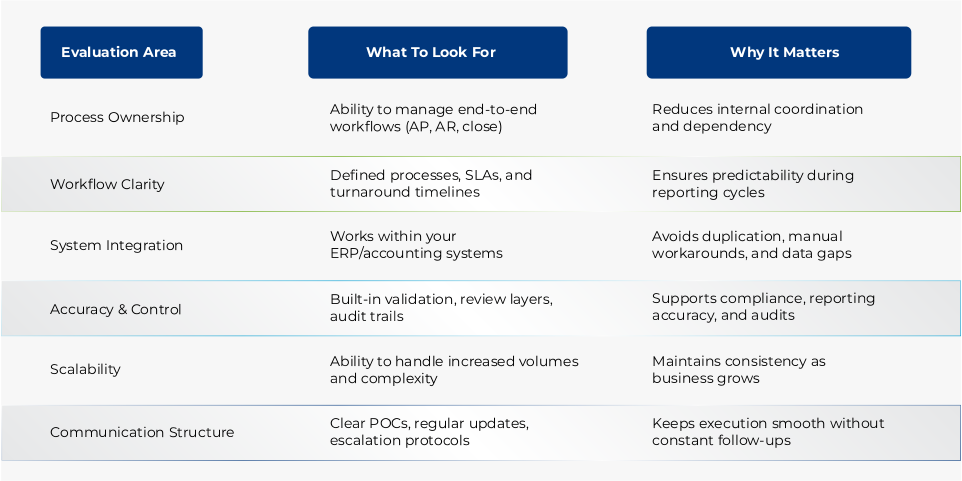
1. Ability to Take Ownership of Processes
A capable partner works at the process level, not just on tasks.
Instead of handling isolated activities like invoice entry or reconciliation support, they should be able to manage entire workflows—accounts payable cycles, receivables tracking, or month-end close support.
This includes:
- managing dependencies across steps
- maintaining consistency in outputs
- ensuring timelines are met without constant follow-ups
Without this level of ownership, internal teams often end up coordinating work instead of offloading it.
2. Clarity in Workflows and Turnaround Expectations
Finance functions depend on predictability.
A strong outsourcing partner brings structure through:
- clearly defined workflows
- documented processes
- agreed turnaround times
This reduces ambiguity and helps internal teams plan around reliable timelines, especially during close cycles or reporting periods.
3. Integration with Existing Systems
Most businesses already operate on a mix of accounting software, ERPs, and internal tools.
An effective partner should be able to:
- work within these systems
- adapt to existing workflows
- minimize disruption during onboarding
Heavy dependence on manual workarounds or parallel systems often leads to inefficiencies and data inconsistencies.
4. Focus on Accuracy, Review, and Control
Speed matters, but control matters more.
A reliable partner builds checks into the process:
- validation steps before final outputs
- review layers for critical transactions
- clear audit trails for tracking changes
This becomes especially important for compliance, audits, and financial reporting.
5. Consistency Across Scaling Requirements
As businesses grow, finance requirements evolve.
Transaction volumes increase, reporting becomes more detailed, and timelines become tighter. A strong outsourcing partner should be able to scale with these changes without affecting quality or turnaround time.
This includes:
- handling increased workload without delays
- maintaining consistency across periods
- adapting to new requirements without rework
6. Communication That Supports Execution
Communication in outsourcing is often underestimated.
It’s not just about responsiveness—it’s about clarity.
A well-functioning setup includes:
- defined points of contact
- structured updates on work status
- timely escalation of issues
This reduces the need for constant follow-ups and keeps processes moving without friction.
When these elements come together, outsourcing begins to function as an extension of the finance team rather than an external support layer.
That distinction makes a measurable difference in how smoothly operations run.
Exhibit 1: Key Evaluation Areas for an Accounting Outsourcing Partner
The Role of Technology in Modern Accounting Outsourcing
Technology has become a defining factor in how outsourcing engagements perform.
Most finance processes today involve a mix of systems—ERPs, accounting platforms, spreadsheets, and reporting tools. The effectiveness of an outsourcing partner depends on how well they operate within this environment and how intelligently they use technology to improve workflows.
The difference is not about whether technology is used, but how it is embedded into everyday execution.
Where Technology Makes a Measurable Impact
1. Invoice Processing and Procure-to-Pay (P2P)
In high-volume environments, manual invoice handling slows down the entire P2P cycle.
With the introduction of GenAI in P2P workflows:
- invoice data is extracted and interpreted with higher accuracy (beyond basic OCR)
- exceptions can be identified based on context, not just rules
- approvals can be routed dynamically based on transaction patterns
This improves both speed and decision quality within accounts payable.
2. Reconciliation and Close Cycles
Reconciliation has traditionally been time-intensive and error-prone.
With AI-supported systems:
- transactions are auto-matched across sources
- anomalies are flagged based on historical patterns
- close cycles become more structured and predictable
This reduces dependency on manual review while improving control.
3. Reporting and Data Visualization
Finance reporting is shifting from static outputs to continuous visibility.
With data visualization tools and real-time dashboards:
- finance teams can track cash flow, liabilities, and performance metrics continuously
- leadership gets access to decision-ready insights without waiting for reports
- trends and risks become easier to identify early
This changes how finance supports the business—moving closer to ongoing decision support.
4. Workflow Execution and Agentic AI
One of the most significant shifts is the emergence of agentic AI in finance workflows.
Unlike traditional automation, which follows predefined rules, agentic systems:
- assess context across multiple inputs
- determine next steps within defined boundaries
- coordinate actions across different stages of a process
For example, in accounts payable:
- a system can identify a discrepancy
- evaluate possible causes
- route it to the appropriate stakeholder or resolve it within set thresholds
This introduces a new level of autonomy in execution, while still operating within controlled frameworks.
Operational Impact of a Structured Outsourcing Model
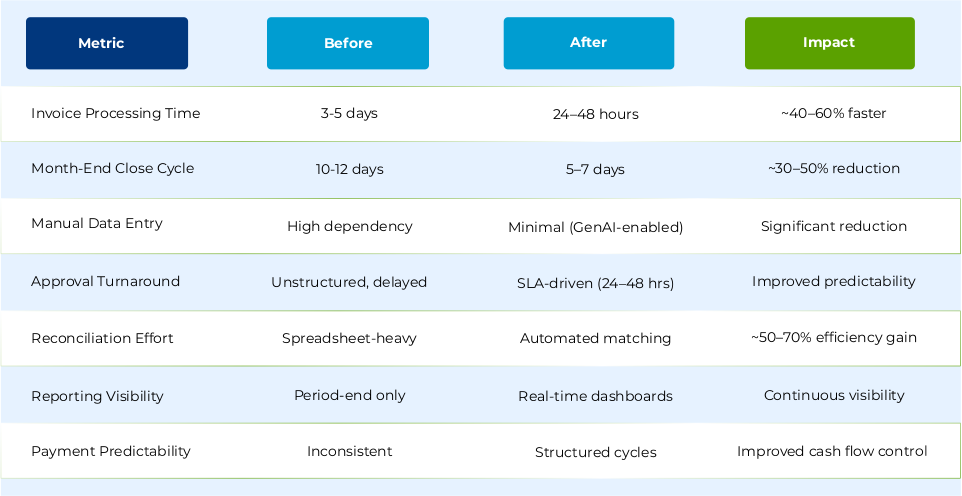
In a typical mid-sized organization, finance operations start showing strain as transaction volumes increase and reporting expectations tighten. Manual invoice handling, email-based approvals, and spreadsheet-driven reconciliation create delays that compound over time.
When a structured outsourcing model is introduced, supported by standardized workflows, system integration, and technologies such as GenAI for invoice processing and real-time data visualization, these inefficiencies begin to decrease. The impact is usually visible within a few reporting cycles, especially in areas such as processing speed, tight timelines, and overall visibility into financial operations.
Exhibit 2: Measurable Impact on Finance Operations
Conclusion
Accounting outsourcing has moved beyond a support function. It now plays a direct role in how finance operations are structured, executed, and scaled.
As transaction volumes grow and reporting expectations increase, the gap between functional processes and efficient processes becomes more visible. Delays, manual dependencies, and limited visibility are often signs of underlying structural issues, not just capacity constraints.
Addressing these challenges requires more than additional resources. It requires a setup in which processes are clearly defined, technology is embedded in workflows, and execution remains consistent across cycles.
This is where the choice of an outsourcing partner becomes critical.
A well-aligned partner brings stability to operations, improves predictability in outcomes, and allows internal teams to focus on areas that require judgment and decision-making.
If your current setup is creating delays, limiting visibility, or increasing manual effort, it may be time to evaluate how your finance operations are structured.
Connect with Accounting TO TAXES team to explore how a more controlled and scalable approach to accounting outsourcing can support your business.